


If depicted in a dot plot graph, the number of subscriptions, tips, websites, and alleged “pros” now available in the investment space would show an explosion equal to a Fourth of July firework.
This side-by-side Motley Fool vs Morningstar review helps investors know the exact value they can expect from both of these products.
Curious, excited opportunists with more time because of remote work are entering the individual investing marketplace eager to learn and spend extra income. In a race to beat stock market losses, investors are hedging their bets on subscription services.
Do stock market investment tools Motley Fool and Morningstar give eager stock market entrants the edge they need?
Stock-picking services can be helpful for investors who are just starting in the stock market. They provide educational resources that can help novice investors learn how the stock market works, provide advice on how to invest wisely, and where to start. Many services offer tools and calculators to help make informed decisions.
Click HERE for more Motley Fool review pricing information
Click HERE for more Morningstar review pricing information
Company History
Morningstar
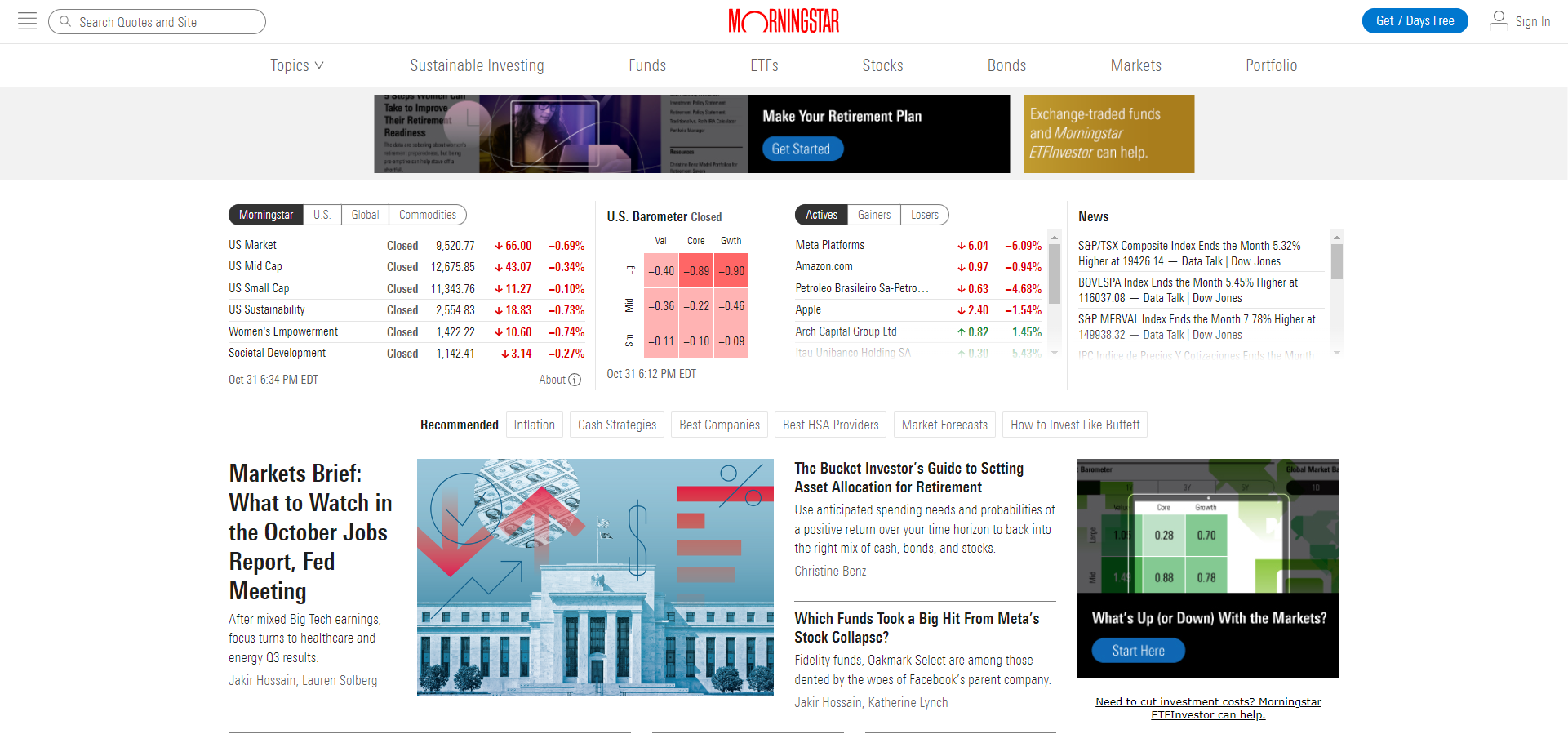
Morningstar is a research firm that specializes in compiling, analyzing, and generally reporting trends in the market. Morningstar analyzes ETFs and stocks. The company is based in Chicago and was founded in 1984. It was led by its founder, Joe Mansueto, until 2017. In 2022, Morningstar introduced a Wealth Management Solutions group.
Its most popular product, used by more than 2,000 individuals and companies in the investment world, is its one-page report on ETF and mutual fund performance. According to Investopedia, The Motley Fool uses its reports as an investment information source.
Morningstar differentiates its subscriber premium product offering with its easy-to-understand platform.
Clear, engaging graphics communicate complex, multi-faceted concepts to help investors and investment groups of every size understand the market and technical trading trends. Both its professional and individual products communicate stock performance and the overall investment health of the portfolio.
Morningstar is a publicly traded company under the NASDAQ ticker symbol MORN.
To the average eye, Morningstar does not stand out as a significant player in the individual subscriber marketplace based on its website and user experience. But upon understanding its research value in the industry for more than 30 years, its reliability as an information source goes up significantly.
Pros:
- Trusted investment research sold commercially to Motley Fool and big brokerages.
- Long, positive reputation
- Publicly traded
Cons:
- Consumer products less well-known
- The lost opportunity to tell the company’s story on the website
- Brand does not attract modern, savvy investor
Motley Fool
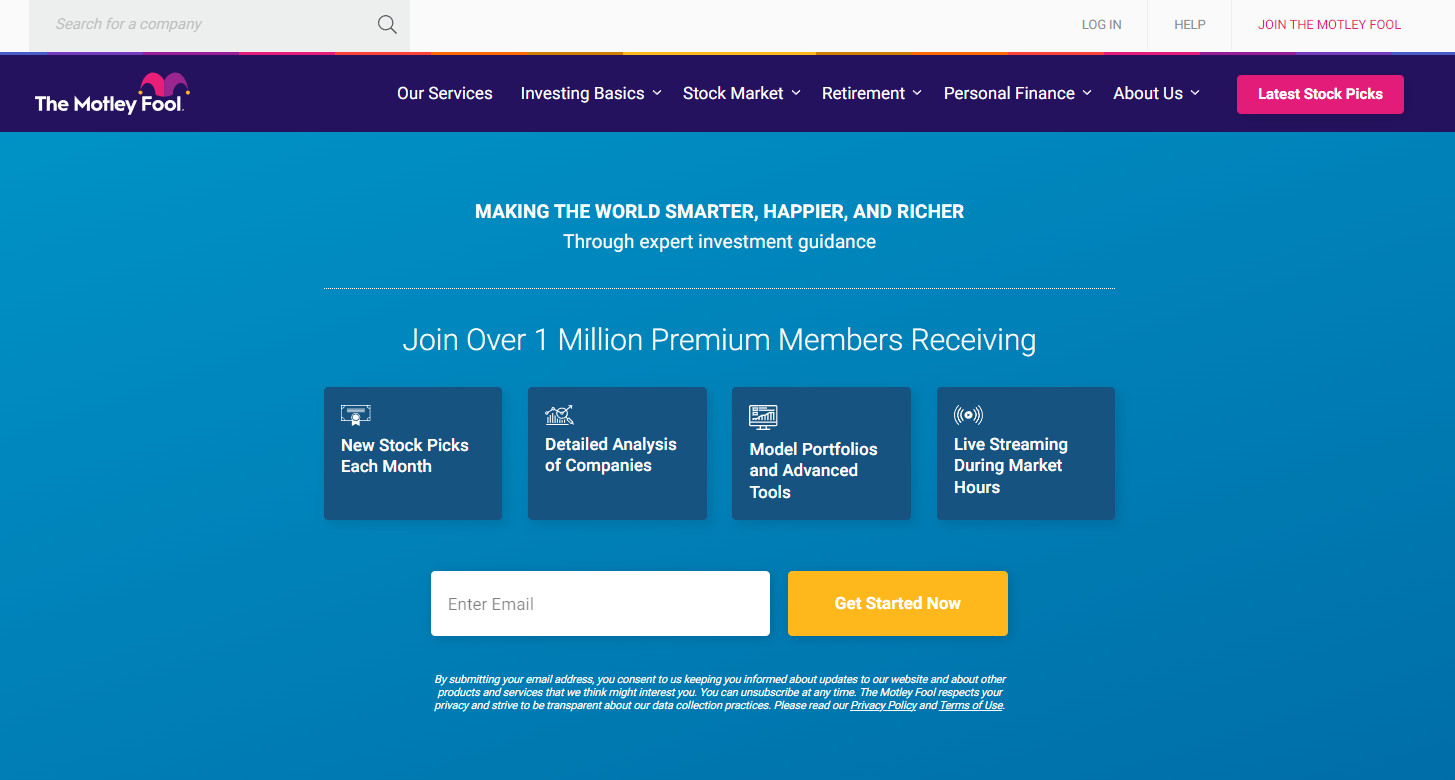
Founded in 1993, Motley Fool is based in Alexandria, Virginia. The company is a private investing and financial advice company that delivers relevant history, analysis, and predictions to paid subscribers. Its investing basics pages are thorough, accurate, and particularly respected as a go-to for new private investors looking to get into the stock market.
Motley Fool has quotes from notable publications like Time and The Economist, recommending the Motley Fool Stock Advisor service. It boasts 1 million members and quotes from subscribers attributing their financial independence to their stock picks. The board of directors has some of the top players in the consumer goods industry adding to its elite status among the smaller players infiltrating the saturated market.
The company has three products: Stock Advisor, Rule Breakers, and Ascent. Rule Breakers looks at market disruptors and high-performers often overlooked in the general market. Ascent reviews consumer financial products like credit cards, mortgages, banking, and personal loans. Stock Advisors provide general stock selections from the general stock market offerings.
Pros:
- Attracts savvy, modern investor
- Board
- Number of users
- Stock performance
- Lots of adjacent product offerings
Cons:
- Privately held
- Upselling products often annoying to customers
Website
Morningstar’s leading sales pitch is that it accesses reports from 150 independent analysts. It goes into relatively detailed descriptions of its user-friendly approach to portfolio and analysis presentation.
Features depicted include:
- Easy to interpret graphics.
- Color-coded analysis of companies based on people, process, and parent.
- Valuation temperature-like scale, showing over-valued stock at a higher degree of red and under-valued price an ever-darkening shade of blue.
Motley Fool also provides subscribers with analyst reports, individual stock reports, and market trends based on data.
Performance
Securities investors can compare Morningstar’s analysis side-by-side with independent analyst valuations of the stock.
Morningstar does not provide individual stock recommendations like the Motley Fool subscription service. Motley Fool is a stock-picking service. In addition to two decades of historically positive returns on picks, it boasts front and center they have 3x’d the S&P 500 since it began.
User reviews seem to be generally positive. Reviewers had used the service for a long period. They reported that as promised, not all investments paid off, but there were some picks they would have not found on their own.
Bloggers and website reviewers ranked Motley Fool as the following:
Number one (traderhq.com, youngandtheinvested.com)
Edge: Motley Fool has numbers to back up its pitch to subscribers. Morningstar has a history to brag about, and an impressive business-to-business sales record, but does not lead with that fact. It could easily boost sales by presenting this. Therefore, Motley Fool gets the edge.
Individual Stock Analysis
Morningstar analysts create a list of stocks and rate them against several categories. Subscribers select their risk level on a five-star scale, and whether to include quantitative analysis.
Subscribers then can filter results and information with the following selections:
- Investment type
- Keyword
- Securities
- Stock style (large, mid, mid-cap, etc)
- Economic moat
- Capital allocation
- Return rate
As described briefly above, users report there was an update within the past year and the new, premium version has bugs. The reports are not easily run and features are difficult to access.
Motley Fool reviewers hotly discuss picks in this volatile marketplace. Reviewers were particularly harsh about crypto investments and other much-hyped picks.
Edge: None. Investors aren’t a very happy bunch lately. The Morningstar subscribers were happy with the ETF information and the Motley Fool Stock Advisor subscribers were happy with the long-term performance, but in the end, it is a tie between the two as each had a group of customers that were not happy.
Presentation
Motley Fool catalogs more than 161 stocks, all with more than 100 percent returns. Within that stock selection, analyst reports, articles, and information related to those stocks are presented from many angles. Motley Fool sends new picks to subscribers every month but does not present them in a dashboard format.
Morningstar presents stocks based on what the user adds to their dashboard. It includes an ideas section, things to remember, and future and past investment choices. Investors can observe trends over a longer period in one easy-to-see place.
One advantage is that Morningstar analyzes an investor’s current portfolio with a trademarked Morningstar Portfolio X-Ray. It looks at portfolio diversity in terms of traditional and non-traditional investment types. Individuals can see how close they are to reaching savings goals and paying off debt. It also includes sector weighings, fees and expenses, and stock stats. It also identifies potential overlap.
The unique presentation of risk, valuation, and market, is appealing. Graphs are typically easier to understand than technical trading terms like stock support, resistance, economic expansion or contraction, position sizing, risk management, and moving average convergence/divergence (MACD). Morningstar makes numbers and analysis less intimidating to the average consumer.
Edge: Morningstar
Price & Value
Morningstar
Price
Seven-day free trial, save $50 off an annual subscription for $199. This is 50 percent off its normal $249 price tag.
Veterans can get the service for free.
Fidelity and T. Rowe Price users can get some of the features like ETF ratings and fact sets for free.
Value
User reviews of Morningstar reported that the analyst articles paid for the membership itself. However, upon digging around the internet, reviews were much more mixed. Positive reviewers reported that they accessed reports through their brokerage.
Motley Fool
Price
Thirty-day money-back guarantee, new members can join for $89, 50 percent off its normal $199 price tag. Immediate access to the stock advisor information.
Value
Motley Fool reviewers seemed generally happy. Poor stock performance for short-term investors expecting guaranteed returns was not good, but they did not follow Motley Fool’s standard advice to hold for at least five years.
Edge: Both. Morningstar’s services are free add-ons to many other financial products and Motley Fool provides a different service than Morningstar.
Customer Service
Morningstar customers had significant complaints about customer service. Mostly related to billing and accessing services.
Motley Fool had very few, and subscribers can access services right away. However, users complained about constant emails trying to upsell products.
Edge: Motley Fool
Conclusion
In a Motley Fool vs Morningstar battle, each was beaten in some significant ways.
Motley Fool led in customer service, performance, and website. Morningstar led in presentation and could have led in company history if its information had been presented differently. Both presented price and value to customers and neither could “win” in the individual stock performance category. Morningstar’s ETF reports and Motley Fool’s stock picks have done well long term.
